
Exploding Cathedrals
Mann, Rolland, Shaw, and the siren of the "Spirit"
Welcome to Garrison Notes, weekly marginalia from the education of a soldier. This week, some notes on the great intellectuals at the start of the Great War. Subscribe for more. Glad you’re here.
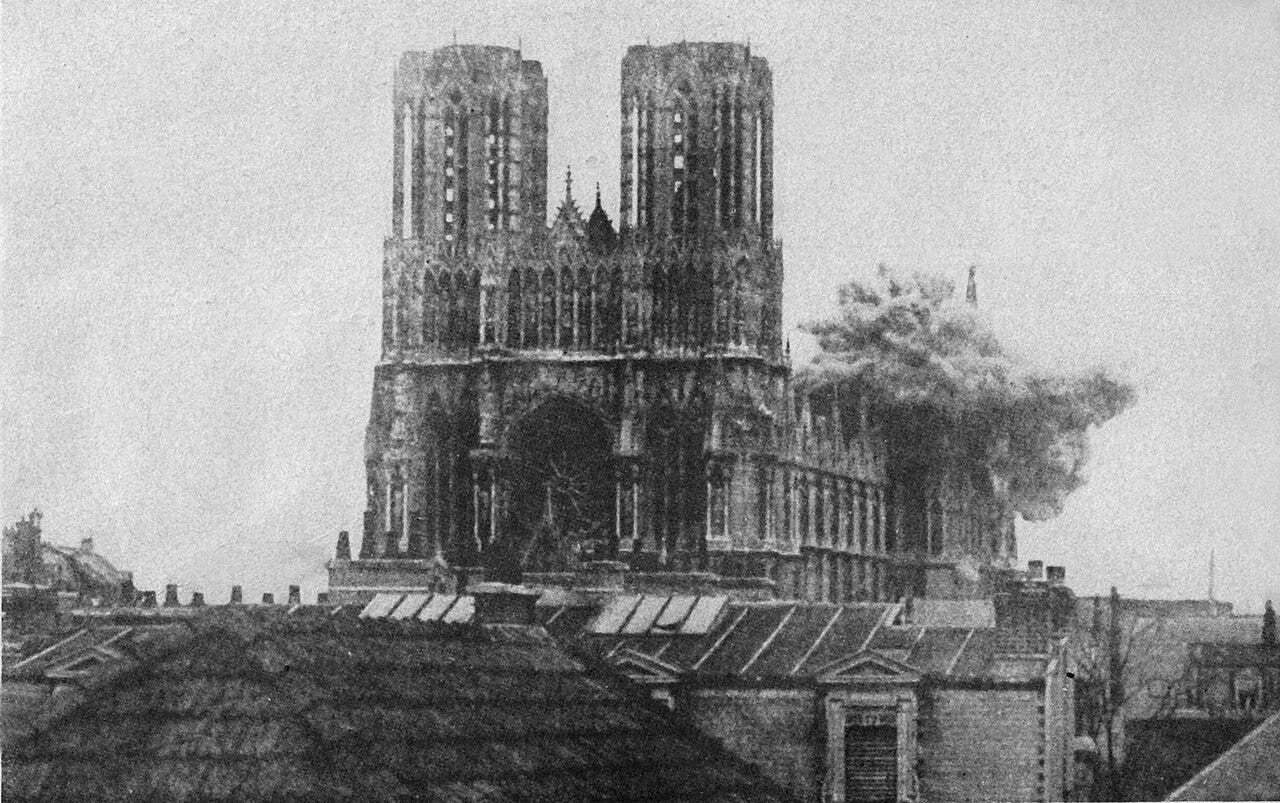
In September of 1914, the German army shelled the cathedral at Reims. The shells started a fire. The flames’ heat made for strange scenes. The mortar joining statuary softened such that angels’ heads fell from their necks. Molten lead from the roof poured through gargoyles’ mouths into the bishop’s palace. Locals watched in understandable horror. Their sanctuary, if only for a moment, must’ve looked like a painter’s vision of hell.1
And the world - or some of it - shared in the city’s horror. Among the allies, the shelling was ready propaganda against the purportedly anti-civilizational Germans. Romain Rolland, the otherwise pacifistic French writer and 1915 Nobel laureate in literature, wrote a petition against the bombardment which he called “Pro Aris.” This excerpt gives one a sense of it:
A piece of architecture like Rheims is much more than one life; it is a people—whose centuries vibrate like a symphony in this organ of stone. It is their memories of joy, of glory, and of grief; their meditations, ironies, dreams. It is the tree of the race, whose roots plunge to the profoundest depths of its soil, and whose branches stretch with a sublime élan towards the sky. It is still more: its beauty which soars above the struggles of nations is the harmonious response made by the human race to the riddle of the world—this light of the spirit more necessary to souls than that of the sun.
Whoever destroys this work, murders more than a man; he murders the purest soul of a race. His crime is inexplicable, and Dante would have it punished with an eternal agony, eternally renewed.2
Some thousand intellectuals on the allied side signed the petition. On the German side, it elicited fury. The already-agitated Thomas Mann answered Rolland’s charges in an passage of his September, 1914 essay “Thoughts in Wartime.” The essay heralded the war not only as a welcome cleanse for a continent seething with vermin (his words) but a epochal battle between German, organic kultur and antiseptic French zivilisation. It was in these terms that Mann considered the bombardment of Reims:
It is also not very soldierly or masculine to demand revenge for half a century, to long for war and finally get it, and then to meet the sacred raging of the elements with the shrill little cry, “Civilization!” You turn Reims into a fortress, you put your cannon in the shadow of the cathedral, you post scouts on the towers, and when the enemy shoots at them, you emit the falsetto cry, “Civilization!” First, Messieurs, Reims Cathedral has absolutely nothing to do with civilization. It is, after all, a monument to Christian culture, the fruit of fanaticism and superstition. The cathedral ought to be painfully annoying to the French Jacobin civilization, or at least a matter of supreme indifference. Which in the end it is. The Catholic officer who was forced to order the bombardment surely has more reverence in his blood for the sanctuary than did the citoyens who thought it should have been destroyed ten times over already in the name of politics.3
These two passages on the Reims bombardment might strike us at first as squarely opposed, but that’s because their charged rhetoric distracts from important if unspoken points of agreement between them. Indeed, these two Nobel laureates are able to clash so fiercely because they’ve common ground on which to meet. I’d like to mark that common ground now, as its existence is instructive.
Both Mann and Rolland suppose that one can discern where the material ends and where the spirit begins. In “Pro Aris,” Rolland wrote that he received letters from soldiers and families alike professing that the shelling of the Reims cathedral was a heavier burden to bear than any loss of life, “because we put spirit above flesh.” This was as Rolland saw it a French characteristic, a civilized one, and “very different is the case of the German intellectuals.”
Mann claimed the inverse. To the extent that one party to the war could claim the side of the soul, of the religious, of the artistic, it was for Mann certainly Germany. So he argued in that difficult book which followed “Thoughts in Wartime,” Reflections of a Nonpolitical Man.4 If the French dealt in the spirit, Mann said, it was of the most alien and empty sort - politicized, humanitarian, classical, universalizing.
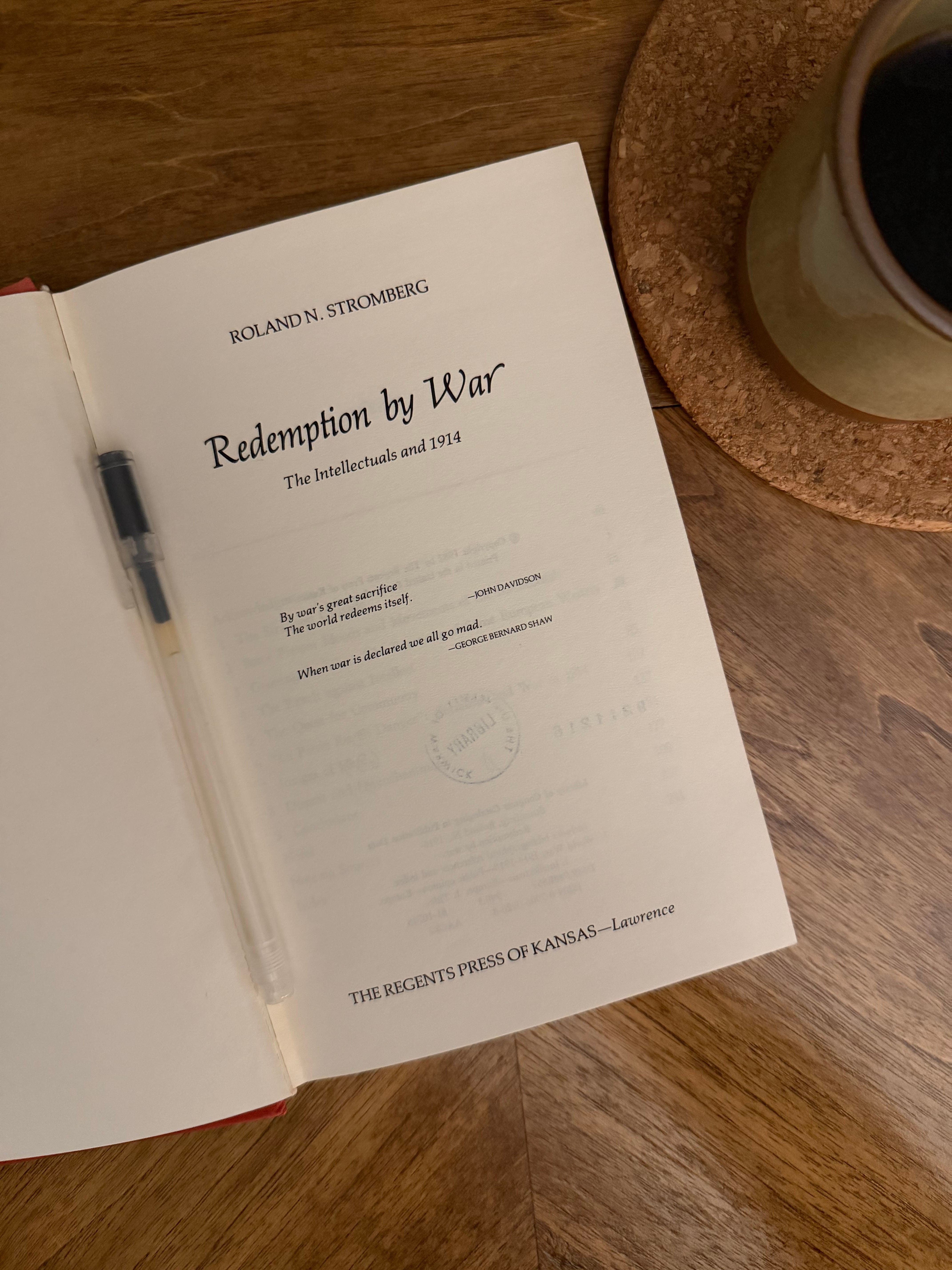
Either way, the two great and troubled minds agreed: there were matters of the earth and matters of the spirit and one ought attend more so to the latter than the former. In this way, Rolland and Mann were only typical intellectuals of their time. So argues Roland N. Stromberg in a compelling volume called Redemption by War: The Intellectuals and 1914. I came across it while trying to learn about the Romantics and the Great War. I am glad I did.
Stromberg’s thesis is this: a great majority of the intellectuals we know and admire from the years before the Great War welcomed the war when it came. This was true of the Romantics, it was true of the Modernists, it was true of the scientists, it was true of the Socialists, it was true of the Catholics and it was true of the Quakers. What’s more, their cheerleading was not a case of temporary insanity, as some later claimed. The near-universal welcome the Great War received followed plainly from the ideas the most serious people had: that there were matters of the spirit and matters of the material world, and that their age had become uprooted and spiritless thanks to a neglect of the spirit and a worship of the material.
This thesis interests me and disconcerts me because these are the concerns with which “the discourse” is most preoccupied today, or so it seems to me (perhaps it’s always this way). The rise of artificial intelligence has only given the matter of spirit and rootedness more urgency. Everywhere it seems people cast about for what it means to be human, rather than just intelligent. This has led people back to Romanticism and to mysticism (Stromberg points out that the occult was all the rage among the educated immediately pre-War, as Mann quite memorably depicted in the seance scenes of The Magic Mountain) .
But as Rolland and Mann alike show, once one gets too sure of a division between the spirit and the material, all sorts of things can go wrong. For one, one risks getting cavalier about destroying the former in droves in order to rejuvenate the latter. One can get all the way to the Battle of the Ypres and beyond, and still think that the worst thing that’s happened yet is the shelling of a cathedral.
This brings me to the most sympathetic figure yet in Redemption by War (I’m not quite done): George Bernard Shaw. Know that I admire Rolland and Mann (particularly the latter, if only out of ignorance of the former), and I’m sure Shaw was imperfect in his way, but Stromberg presents Shaw’s pro-war sentiments as grounded and fatalistic, rather than enthusiastic, spiritualized, or, to use his own words, “treacly” like Mann and Roland were.5 Unlike some 250 other British intellectuals invited, Shaw declined to sign Rolland’s petition against the bombardment of Reims Cathedral, and wrote this as an explanation:
…if I were a military officer defending Reims I should have put an observation post on the cathedral roof; and if I were his opponent, I should have to fire on it."
This matter-of-fact voice reminds me of Robert Graves. He was the subject of last week’s Garrison Note, as I’ve just finished Goodbye to All That. The accounts Graves gives of the trenches, of his reasons for fighting, of his willingness to return to the trenches, his impatience with Romantic ideas about the spirit - these things accord with Shaw quite neatly. Stromberg notes well the short lifespan of high-flying ideas in the trenches - Graves perhaps does it better. Let’s make his the last word. A Robert Graves poem that answers Rolland and Mann alike:
Kill if you must, but never hate:
Man is but grass and hate is blight,
The sun will scorch you soon or late,
Die wholesome then, since you must fight.
Hate is a fear, and fear is rot
That cankers root and fruit alike,
Fight cleanly then, hate not, fear not,
Strike with no madness when you strike.
Fever and fear distract the world,
But calm be you though madmen shout,
Through blazing fires of battle hurled,
Hate not, strike, fear not, stare Death out!
Two good, short write-ups come from Rens Steehard of the Carnegie Foundation’s Peace Palace Library and James Clark over at History Today.
This version was published with his collection of essays, Above the Battle, run in 1915. This excerpt is from a translation by C.K. Ogden that one can view at Project Gutenberg.
Thomas Mann, “Thoughts in Wartime” trans. Mark Lilla and Cosima Mattner, in Reflections of a Nonpolitical Man (New York: New York Review of Books, 2021), 503
Examples abound in this repetitious book. See Mann, Reflections, 120. See also 27.
Roland Stromberg, Redemption by War: The Intellectuals and 1914 (The Regents Press of Kansas, 1982), 47-48,
That picture is truly something. Photographic technology 112 years ago was nothing like today and that someone with a camera handy could capture that moment in time is truly remarkable. As for the main thesis, objects/places of cultural significance have done a lot throughout the history of warfare to inspire men to fight more than they might do so otherwise. Verdun serves as a prime example.
Your provocative essay immediately reminded me of Anselm Kiefer's burning cathedrals, homages to Rodin's only book 'Cathedrals of France', published a few months before the 1914 bombing of Reims. When Rodin heard the news he was apparently devastated. According to a witness he "turned pale as if he was dying". But surprisingly, he was dead set against any restoration of Reims, in spite of the heavy damage. For him it was part of the evolution of the building--an idea that aligns with Kiefer's aesthetics of ruination which stem from his childhood spent in the ruins of World War 2 Germany. I haven't found out if Kiefer was also reacting to the Reims bombing, or just to the Rodin book. But if you see the image at the beginning of an article I wrote on Kiefer at the time of the Notre Dame fire, you see a firebomb level of destruction going on. https://substack.com/@brooksriley/p-159188355
Something else occurred to me: The differing attitudes of Rolland, Mann and Shaw stem directly from their cultures--with the French and German much closer in 'spirit' than the pragmatic British one.