
Modern Dance
Marginalia from Modris Eksteins's Rites of Spring
Welcome to Garrison Notes, a newsletter of marginalia from the education of a soldier. This week, marginalia from a magnificent cultural history of the First World War called Rites of Spring, one of several Garrison Notes written already or forthcoming about the turn of the century. Thank you for reading. Eager for your thoughts in the comments.
Good morning,
For a book on mass death, Modris Eksteins’s Rites of Spring: the Great War and the Birth of the Modern Age opens in an unexpected way: with ballet. If I knew my dance better, the book’s title, taken from Igor Stravinsky’s 1913 ballet, might’ve given it away. But I don’t, and so had to adjust. Only a little more predictable is how Eksteins chose to close his book: with the impromptu dance party thrown by Hitler’s staff on April 28th, 1945 in the Führerbunker’s canteen, just as the bunker’s namesake prepared to kill himself alongside his bride some levels below.
So dance brackets the Rites of Spring, and from opening to final number, Eksteins treats his audience to an unrelentingly dense study of the First World War. Along the way one meets an almost impossibly big cast - not just Stravinsky and Diaghilev and Nijinsky but also the racialist Houston Stewart Chamberlain and the hedonist poet Harry Crosby and John Stuart Mill and Louis Mairet and Charles Lindbergh and Isadora Duncan and F. Scott Fitzgerald and Henry James and Coco Chanel and Goebbels, in addition to the familiar Great War faces - Graves and Owen and Sassoon and Remarque and so on.
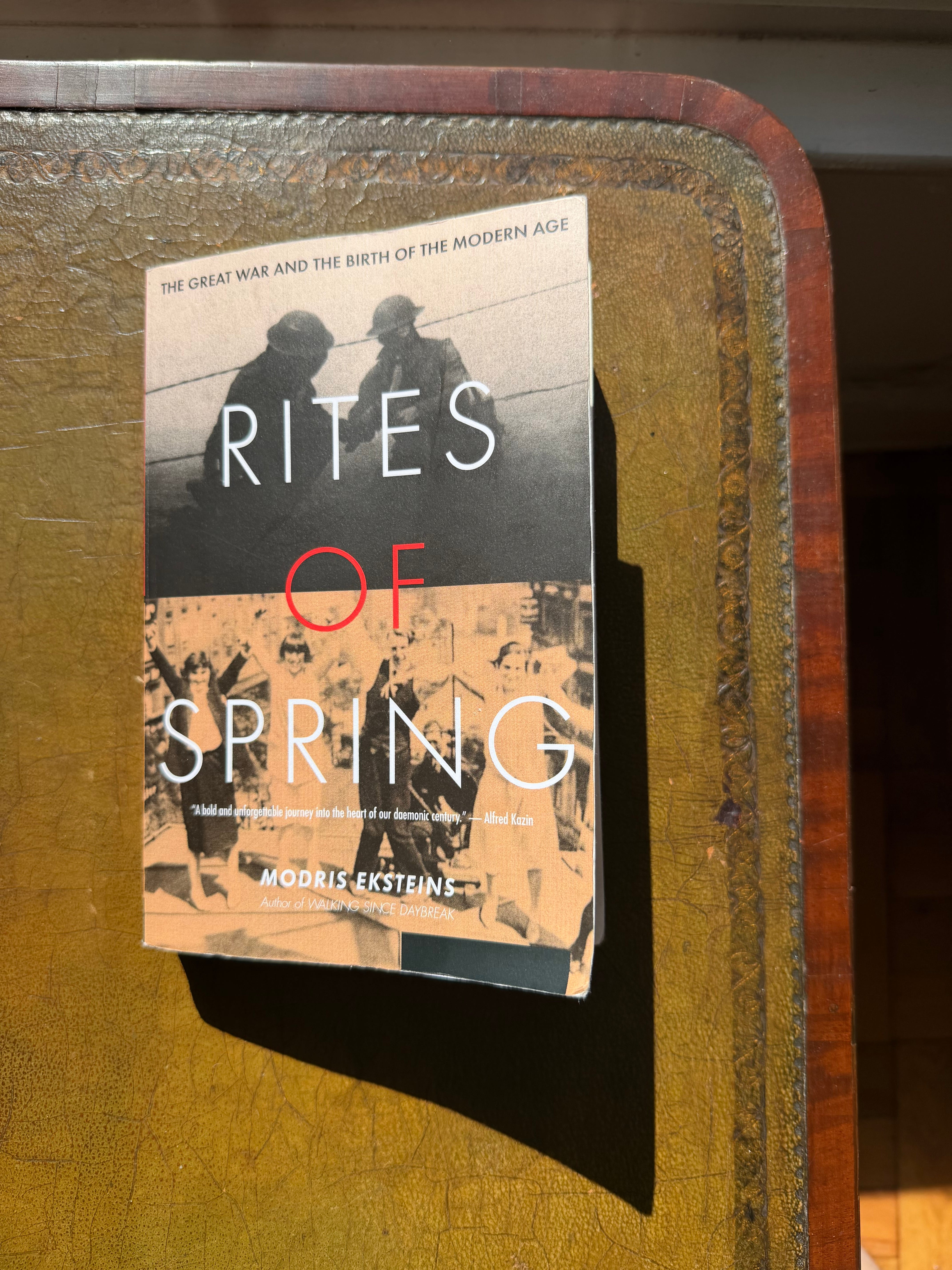
This letter offers marginalia on just one theme of Eksteins’s study, perhaps his central one: the nature of modernity. My reasons for this are the same as those for which I picked up Eksteins in the first place: the theme and book alike sit at the convergence of topics about which I am trying to know more. Readers of Garrison Notes may detect that of late I’ve been trying to learn about the change from the 19th to the 20th century in the West. I’ve also tried to read literature, and to understand a little about war, particularly the Great War. To these ends, Rites of Spring is immensely useful.
What follows is likely intuitive to readers, but perhaps in part because Eksteins’s 1989 book, much honored and read, so cohered it all in our collective understanding years ago.
The West chafed against forms pre-War, particularly Germany.
The reason Eksteins begins with Stravinsky’s Rite of Spring (or le Sacre du printemps) is that the ballet to Eksteins’s eye presaged the impact of the First World War on the western mind. The ballet does so via its asymmetry, its “thick melange of instinct, sensuality and fate,” and above all its freedom:
The ballet contains and illustrates many of the essential features of the modern revolt: the overt hostility to inherited form, the fascination with primitivism…the perception of existence as continuous flux and a series of relations, not as constants and absolutes…1
The urge for freedom, as the avant-garde felt it, did not have practical content:
Despite a fascination among the avant-garde with the lower classes, with social outcasts, prostitutes, criminals and. the insane, the interest usually did not stem from a practical concern with social welfare or with a restructuring of society, but from a desire simply to eliminate restrictions on the human personality. 2
Though Rite of Spring was a ballet put on by the Russians in France, Eksteins states that Germany was the country in Europe best positioned to leap into modernity. It was so because of the speed and the violence with which Germany had industrialized in the preceding five decades. Every great power in Europe had changed, but maybe none faster than Germany. A century of development it seemed had been compressed into barely a generation: From 1870 to 1914 Germany had gone from a two-thirds rural to a two-thirds urban country. In 1870 British steel manufacturing was quadruple that of Germany - by 1914 Germany’s was that of Britain, France and Russia combined. The population had grown by a quarter in twenty years, far outstripping the pace of populations in France and Britain. Most of the new laboring masses worked in industry - an alien, fast and disorienting place, to the extent it existed.3
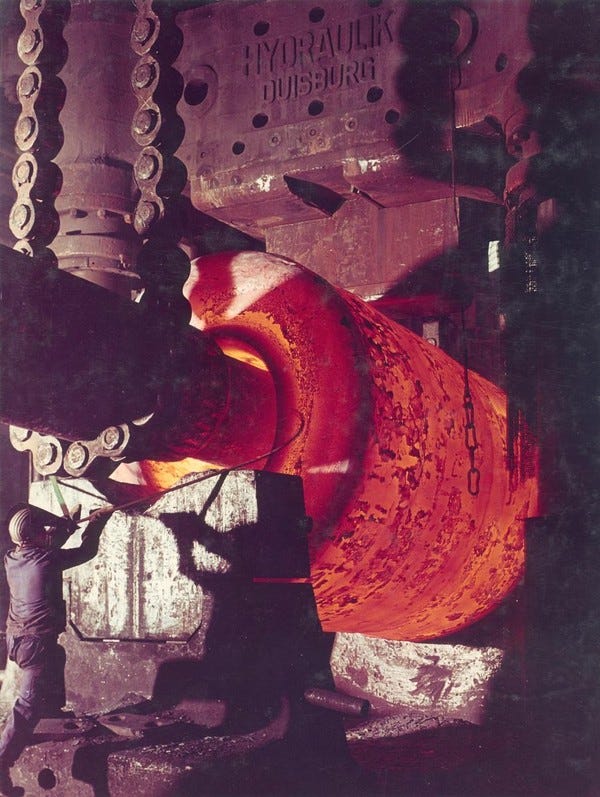
All this change - the electrification of things in a short time period, the upsetting in mere years of centuries’ life patterns, new trade, fast trains, the inevitable motor car - made received forms look silly (“Nothing could be less conservative” quotes Eksteins from a Bismarck-era German conservative, “than to fight for forms which in the course of time have lost their importance”). When paired with high rates of technical education and a sense of kultur (that being a German preoccupation with matters of the underlying spirit - covered also by this Garrison Note but better by Elan Kluger here),4 such rapid change primed Germany to most readily make sense of the blow the Great War would deal to received forms everywhere.
This particularly German readiness for the War and its emancipatory effect was embodied, as Eksteins tells it, by the Kaiser - a restless man whose short attention span was inclined towards lavish if not transgressive performances - such as the ones given by Dietrich Graf von Hülsen-Haeseler, the Kaiser’s chief of the military cabinet, wherein he appeared in a tutu for the court and danced like the ballet. Hülsen-Haeseler died of a heart attack at the end of one such performance in 1908 - a portent of the maiden who dances herself to death in Rites of Spring (its these sorts of stories that Eksteins has just a genius for digging up and for arranging so as to make clear their resonance). The Kaiser, remarked one observer, wanted his pursuit of a “complete break with the old.” Well, he got one.5
The Great War destroyed those forms.
This section might seem redundant, the story of the Great War’s slate-wiping violence is so tired. But Eksteins somehow writes it new. He chooses to do so in four ways that struck me:
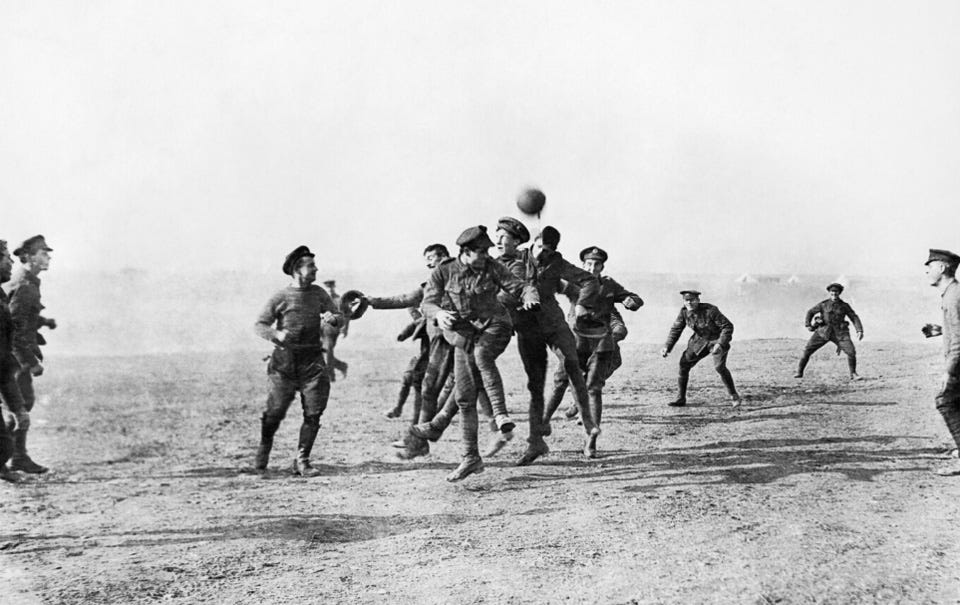
The moderns don’t play games. Eksteins traces the declining rates of fraternization between the warring sides from the famous Christmas Truce of 1914 onward. His basic point is that the Christmas Truce, wherein the British Expeditionary Force and their German counterparts alike put down their weapons and played what in Europe they call football to mark the holiday, was a pre-modern century event that celebrated “history and tradition”. The game on one portion of the front allegedly started when soldiers from both the opposing trenchlines went chasing gleefully after the same hare, the hare itself seeming a visage of the bucolic, pre-urban 19th century. Eksteins goes so far as to argue that the soldiers who most enthusiastically partook in the Christmas Truce festivities were from the least modern regions of the warring sides - Bavaria, Scots, Saxons. The least participation was seen among the most modern variant of German: the Prussian.6 But as the war dragged on, it claimed such gaming spirit as just another casualty. By 1918, all belligerents were modern, the war was total, and constraining forms of regionalism or tradition were buried.7
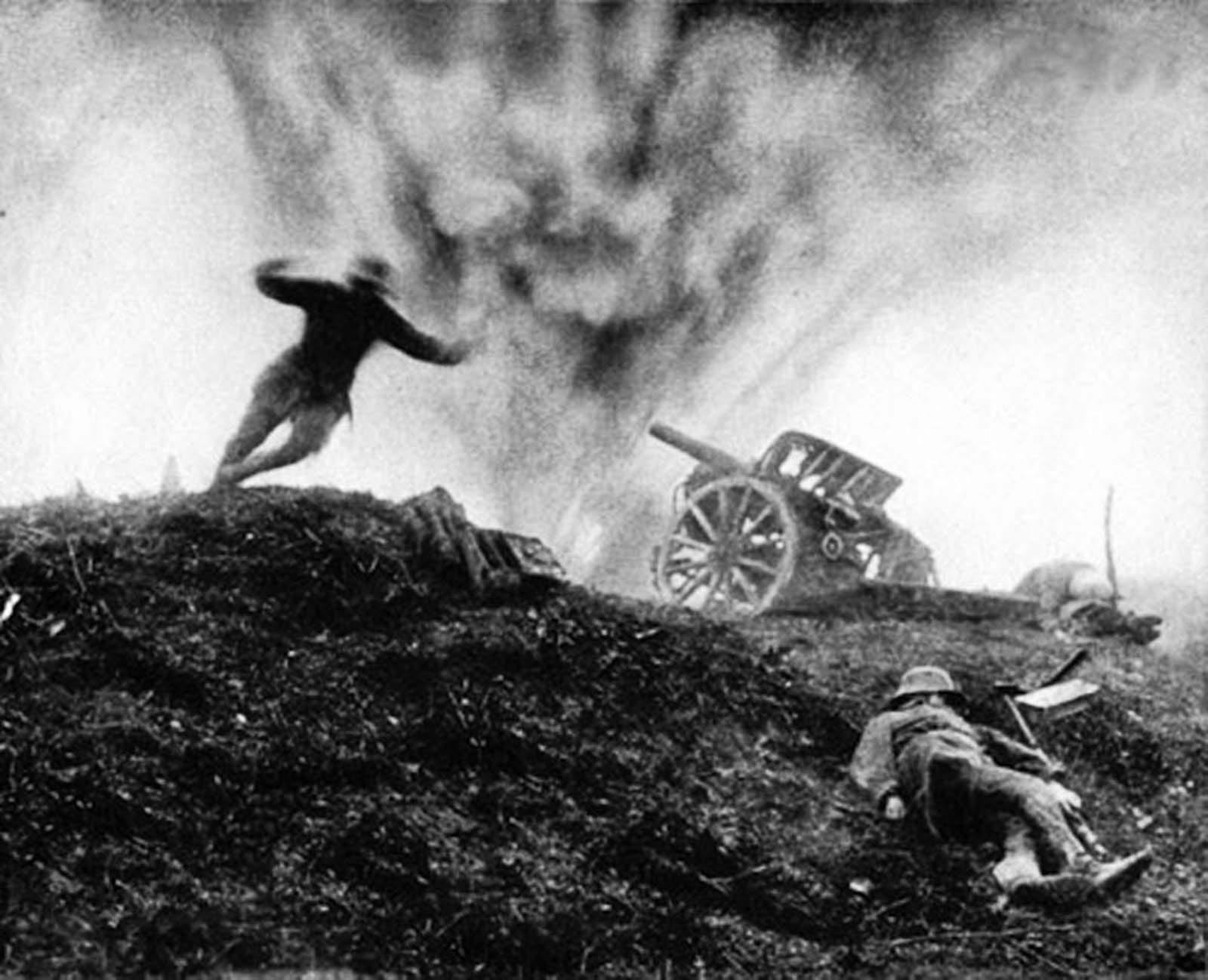
Artillery is modernity in a canister. One might think that a writer has to choose between writing in a learned way about the choreography of Nijinsky or the tactile experience of storming a machine gun nest. Eksteins proves one can do both. The effect is heightened by his exhaustive use of primary sources, which he charges with much meaning.
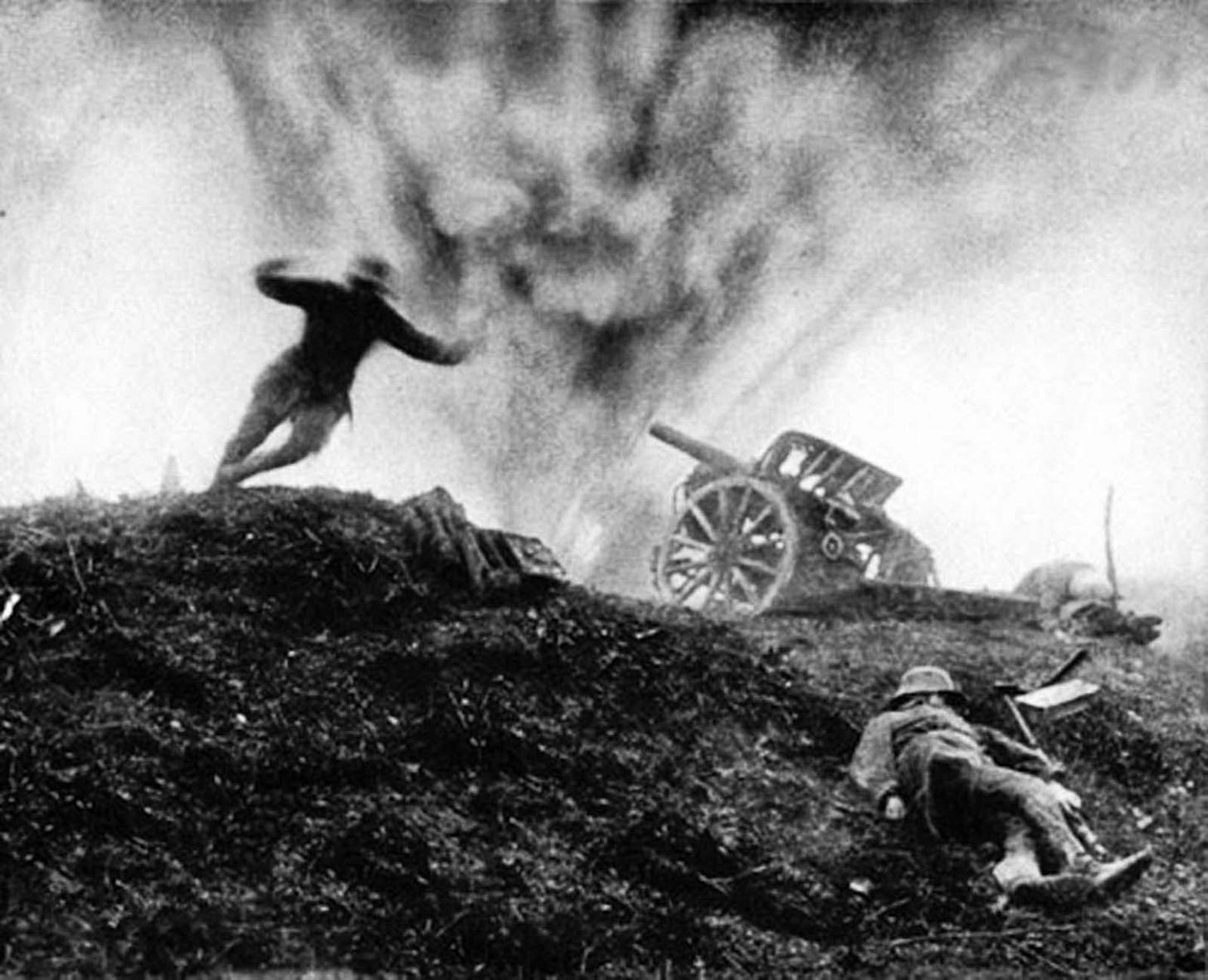
Here he quotes an officer, and in the quote sees an image of unconstrained (dancing) modernity in an account of a shell-burst:
Two men suddenly rose in the air vertically, fifteen feet perhaps, amid a spout of soil 150 yards ahead. They rose and fell with the easy, graceful poise of acrobats. A rifle, revolving slowly, rose high above them before, still revolving, it fell.8
What immediately follows is perhaps the best stretch of the book, in terms of both content and craft, is Eksteins’s depiction of what it is like to go over the top:Defenders huddle either in “funk holes” burrowed out of the forward side of the trench, or in dugouts, often fifteen to twenty feed underground, perhaps five paces square and about six feet high…Acetylene flights and candles flicker. Larger concussions extinguish them altogether. A respite, will it come?…Will the cycle begin again? Is the attack on its way? Have the sentries survived? Are the periscopes manned? For when the attack comes, there will be a “Race for the parapet,” up the dugout steps, should that still be possible…On the other side of no man’s land men wait. Faces assembled at scaling ladders are drawn and ashen. The tot of navy rum or Schnaps or pinard, which have been distributed a few minutes earlier, can dull the senses but not reverse the flow of blood...A few men chatter nervously. Some exchange fianl wishes. Some whisper prayers….Zero. A shrill whistle. The wave of a cap. Men clamber up ladders. Manny are clumsy - because of the load, from fear, or by nature. Over the top! Physical nakedness is the first sensation…Then the advance. Slow and faltering…The Germans and French are more innovative, often rushing forward in groups. The British are more systematic….The cratered honeycomb of no man’s land quickly breaks down any planned order. Men slip and fall. The line becomes straggly. Some get up and continue. Others cannot. In the mud of Passchendaele in 1917 some men drown in the huge, sewerlike craters filled with slime that comes of rain, earth and decomposition.9
Later he emphasizes the particularly German embrace of formless war - not just the Schlieffen Plan, which he reads as a modernist document, but also gassing, and unrestricted U-boat warfare, and so on. The Germans pushed modernity in the war furthest, he seems to say.10
The war atomizes men and so makes them modern. Eksteins makes the case that the war’s bleakness severed men from anything but the man next to him and ultimately, themselves. It’s a cliche that soldiers fight for those serving to their left and right, but Eksteins argues that this was particularly true of the Great War, for the war’s mass violence and suffering and stasis rendered every other possible cause ridiculous. This was the consequence especially of the middle portion of the war, from which we get its enduring images and names - the Somme, Verdun, Passchendaele, stalemate, no-man’s land, attrition, trench warfare, futility. So writers like Robert Graves and Siegfried Sassoon, though they never lost a moral sensibility, became self-obsessed and hostile to politics. “With time,” Eksteins concludes, “the former categories and accepted relationship of the war to previous history wore thin and collapsed…in the cauldron where purpose, memory and outcome brewed together, the validity of former categories disintegrated.”11
And duty kept the men going? The least convincing part of the book, possibly because of my own sentimentalism, is the portion where Eksteins explains why the war kept going, rather than ceasing in the face of such horror. His answer is “duty.” The idea that despite the aforementioned severance of soldiers from any pre-war identity or form, an enduring bourgeois sense of duty sent them over the top. Even when soldiers stopped invoking duty, Eksteins, otherwise ready to put much stock in what people say or write, says it “had less to do with the disappearance of the concpet of duty” than muteness brought about by war.12
The British and Americans were particularly susceptible to such ideas for the completeness of their bourgeois education, dating back to the ideas of John Stuart Mill, and the Somme represented the terminus of such life. He closes this portion with an astounding excerpt from Tender is the Night, wherein the narrator says of the Somme “This took religion and years of plenty and tremendous sureties and the exact relation that existed between classes…there was a century of middle-class love spent here…All my beautiful lovely safe world blew itself up here with a great gust of high explosive love.” The quote alone convinced me to pick up Fitzgerald again, even if hits suspect on my ear.13
Part of what weakens Eksteins’s case here is that he seems to contradict himself (though given how much he thought about this book and how much he knows, I’m likely wrong). Soldiers at once in his telling fought because of duty and fought to escape it. This sort of stuff can be squared with unfalsifiable conceptual pirouettes, but the impression stuck with me regardless. To his point, here’s that hedonist Harry Crosby (about whom I knew nothing and whose Wikipedia, I’ll just say, is a trip), talking about exactly what he wants to escape:the horrors of Boston and particularly of Boston virgins who are brought up among sexless surroudnings, who wear canvas drawers and flat-heeled shoes and tortoise-shelled glasses and who, once they are married, bear a child punctually every nine months for five or six years and then retire to end their days at the Chilton Club. Christ, what a narrow escape.14
Duty, indeed.
A distinctly modern freedom emerged from the rubble.
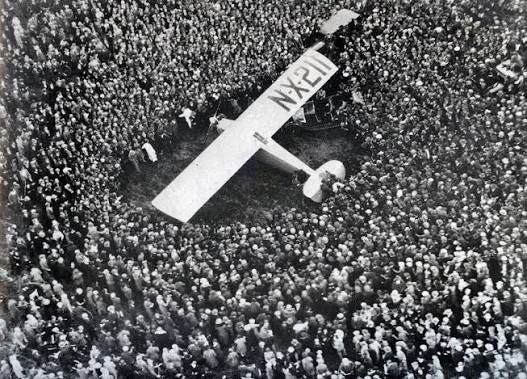
If his description of a trench assault isn’t it, perhaps the best part of Rites of Spring is Eksteins’s entirely unexpected start to his third act. He begins the act by retelling vividly the arrival of Charles Lindberg in Paris at the conclusion of his transatlantic flight in 1927. The sheer delirium with which Lindbergh was greeted - the hundreds of thousands, the clogging of the roads for miles about Paris to create the world’s first traffic jam (as Eksteins says - I imagine the operational planners of the 1917-1918 offensives would dispute this), the way worshippers ripped the plane to shreds depite the strenuous efforts of police, the way Lindbergh had to be spirited away in disguise lest he be harmed amid the uncontainable rush of fans, the greetings by the heads of state, the drama of each successive descent - it all is stranger than fiction (and somehow, forgotten? Or rather, at least unknown to me, which is of course not the same thing as forgotten).
Eksteins purpose in introducing Lindbergh is to present to the reader an embodiment of post-war modernity. The presentation is compelling. Lindbergh was certainly an icon - Eksteins invokes contemporaneous descriptions of Lindbergh as a a “new Christ”, a man who only drank water, did not dance (a rare narrative violation in this otherwise almost painfully coherent book), was unfailingly kind, met with rapture everywhere as if a deity, seemed to perform miracles. But more importantly, Lindbergh had flown and done it atomized, alone:
The modern sensibility, however, was equally exhilarated. It was enchanted above all by the deed. Lindbergh had not swum the Atlantic nor rowed across it nor catapulted over it. He had flown! Man and machine had become one in this act of daring. The purpose was immateria. The act was everything. It almost captured Gide’s prewar vision of an acte gratuit, a perfectly free act, devoid of meaning other than its own inherent energy and accomplishment. And Lindbergh had been alone on his flight, completely alone, free of civilization and its constraints, in communion with the oceans and the stars, the winds and the rains. He flew for no one, not even for mankind. He flew for himself. That was the greatest audacity - to fly for himself.15
From there Eksteins takes the reader on a whirlwind tour of a culture across the West - from Musil to Mondrian to Klee to Montherlant to Eliot (Eliot is frequent) - marked by “movement, melancholy and neurosis,” wherein the self and freedom for its own sake - rather than, say, a freedom arisen from discipline to do the virtuous thing, per J.S. Mill - was paramount.16 (It’s worth noting that Eksteins does not dismiss all moderns as equally nihilistic or flimsy. He reserves praise for some, especially Eliot, but probably not enough. Jonathan Rose made this point well in a review of the book for Commentary.)
Either way, you might find yourself asking: where, does Eksteins say, did all that lead?
In Germany, Nazism followed.
If you haven’t read the 20th century story yet, please do not read further or else forgive this letter for ruining the century’s middle part. But, spoiler: Nazism. This led to Nazism. That’s Eksteins’s answer. Here is how he describes Nazism:
The ideas he and the party spouted were all tattered; they were nothing but jargon inherited from the paranoid Austro-German border politics of the pre-1914 era…It was not the substance - there was no substance to the frantic neurotic tirades - that allowed the party to survive and later grow. It was the style and the mood. It was above all the theater, the vulgar “art,” the grand guignol productions of the beer halls and the street…Nazism was not a party; Nazism was an event.17
That is why, in Eksteins’s telling, the tributes the Nazis paid to the virtuous countryside and master race genetics and the small shopowner were contradicted by the urbanization that occurred under them and the deviant appearances of their own leadership and the economic concentration they oversaw - their ideas were never meant seriously except in service to the performance.
And that performance eventually, thankfully, ended. Hitler, Eksteins seems to suggest, danced himself towards death not unlike the maiden of Stravinsky’s imagination, as did the Nazi movement, until the Fuhrer found himself buried underground, encircled by the Red Army, preparing to take his own life while his few remaining staff danced nihilistically upstairs.
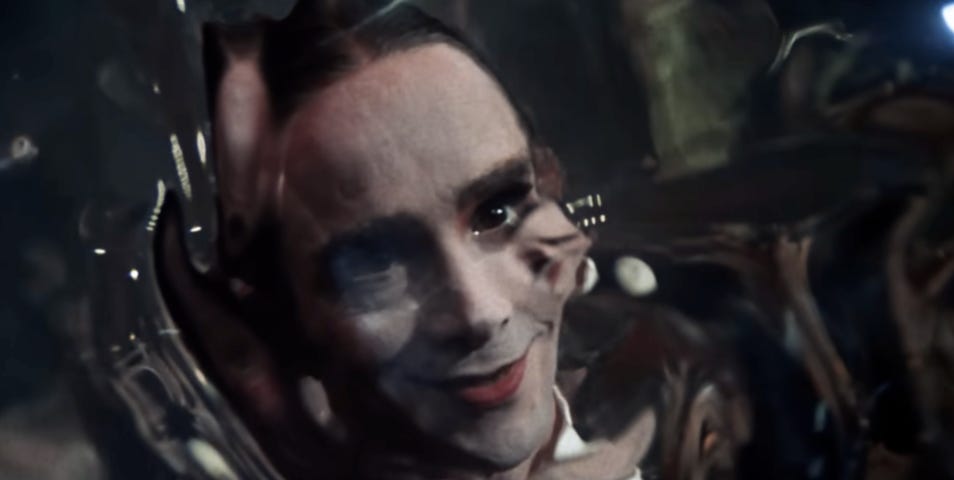
Rites of Spring made me think of many things, and I aim to draw on it more this summer. But what returned to me again and again (as the lead photo hints), in addition to things like The Radetzky March and Berlin Alexanderplatz, is Bob Fosse’s 1972 film Cabaret. The slide of the cabaret towards the Nazis 1930s, the limits of transgression for its own sake, the atomization of post-war Germany - these themes seem to be very much Eksteins. That’s to say nothing of dance as an image and act.
Still, neither the musical nor Isherwood’s Goodbye to Berlin earns a mention (though Isherwood gets two). A cursory search turns up no comment from Eksteins on the play elsewhere. So I’ll close with the emcee, who seems to have understood all of this, from the first bienvenue to “I told you so”:
Modris Eksteins, Rites of Spring: The Great War and the Birth of the Modern Age (New York: HarperCollins, 1989), 52
Eksteins, 42
Eksteins, 69
Eksteins, 72-73
Eksteins. 88-89
Eksteins, 133
Eksteins 133-136.
Eksteins 140
Eksteins, 141-142
Eksteins 167
Eksteins 155
Eksteins, 184
Eksteins, 191
Eksteins, 215
Eksteins, 251
Eksteins, 267
Eksteins, 313