
The Prosaic Courage of Robert Graves
Marginalia from Goodbye to All That
Garrison Notes offers weekly marginalia from the eduction of a soldier. Welcome.

Good morning,
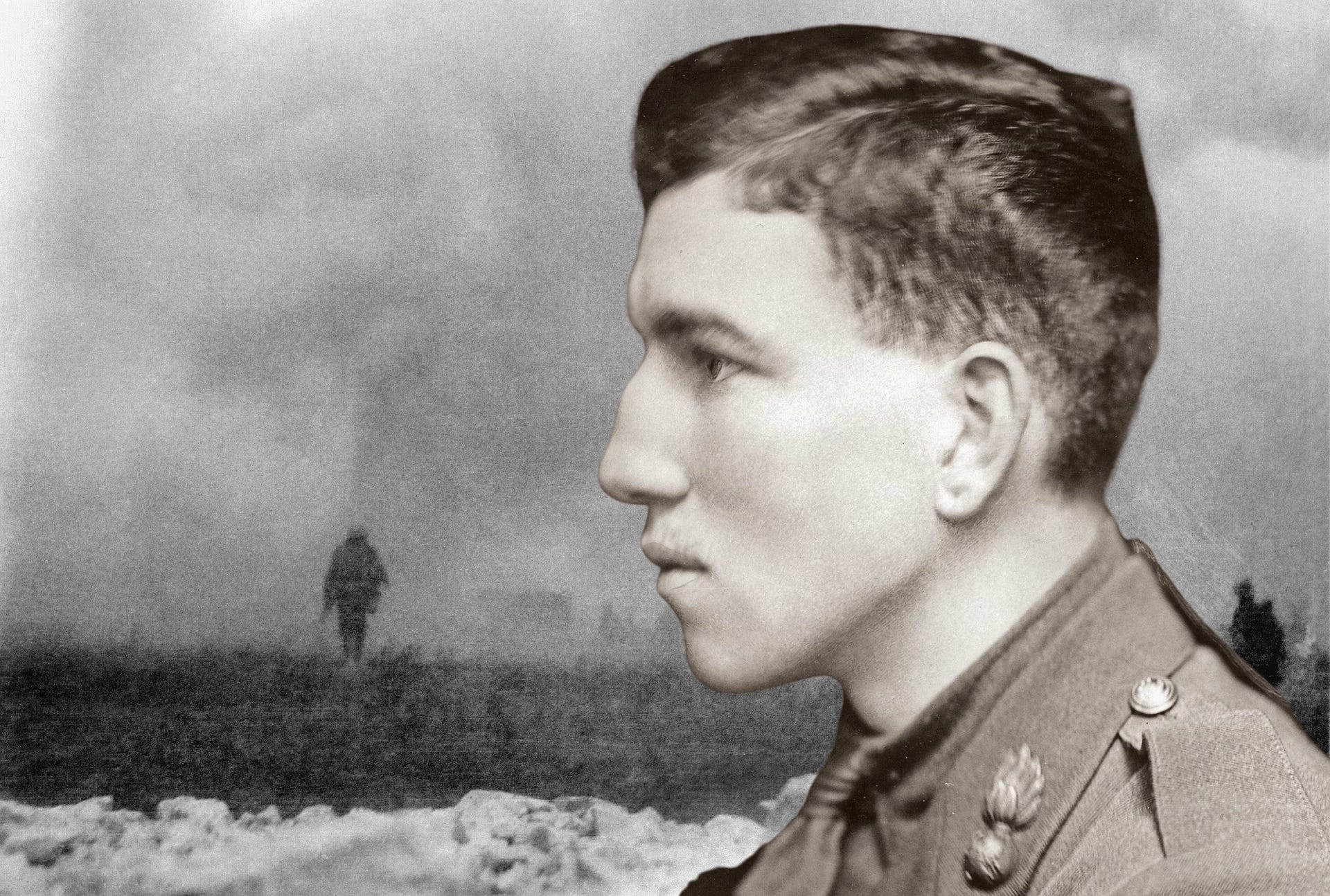
Romanticism has already once led me to the First World War. It did so via Germany. There romantics yearned for, then welcomed war’s outbreak as a spiritual cleanse. Now I come at the war by the British way, curious to see if there’s an Anglo analog. My guide to start has been a memoir first published in 1929 called Goodbye to All That. Its author is a Great War veteran and poet named Robert Graves1
The thing I want to do in this short letter is mark a distinction Graves draws, if only indirectly, between different sorts of courage he saw while in the trenches of France. One sort of courage we might call romantic courage. We know it for its physical daring, its individuality, its drama and its sentiment. The other sort of courage we might call prosaic courage. We don’t know it, really, and that’s because it’s marked by a quiet but reliable doing of one’s duty, by an anonymity.
In Goodbye to All That, romantic courage finds expression in the person and acts of Siegfried Sassoon. Some readers may know Sassoon as another of the great war poets. They may also know him as author of the George Sherston Trilogy, three novelized memoirs that chart the loss of pre-war Georgian innocence. Its most famous book is its middle book, Memoirs of an Infantry Officer.
But when Graves met him at a company mess near Cambrin in 1915, Sassoon was still a barely-published country gentleman with a poetic habit. They were two officers, commissioned through the Special Reserve, with the Royal Welch Fusiliers. As is fitting, a book brought the two poets together. Here’s Graves, having just returned to the front from a reorganization in the rear, recalling the moment:
A day or two after I arrived I went to visit ‘C’ Company Mess, where I got a friendly welcome. I noticed The Essays of Lionel Johnson lying on the table. It was the first book I had seen in France (except my own copies of Keats and Blake) that was neither a military text-book nor a rubbishy novel. I stole a look at the fly-leaf and the name was Siegfried Sassoon. Then I looked around to see who could possibly be called Siegfried Sassoon and bring Lionel Johnson with him to the First Battalion. The answer being obvious, I got into conversation with him, and a few minutes later we set out for Bethune, being off duty until dusk, and talked about poetry.2
They went on to swap poetry (Graves thought Sassoon’s was then still too sweet about war, and said he’d learn soon enough - this already a comment about romanticism broadly defined). From there on the reader hears from Graves intermittently of Sassoon, more of Sassoon’s battlefield conduct than of his poetry.
As it turns out, Sassoon’s battlefield conduct was remarkable. Graves presents him as an almost supernaturally daring officer, given to nighttime patrols alone, made not to troop a line but to kill Germans. When a German potshot killed the officer and poet David Thomas, whom Graves loved and with whom Sassoon was in love, their reactions differed:
I felt David’s death worse than any other since I been in France, but it did not anger me as it did Siegfried. He was acting Transport Officer and every evening now, when he came up with the rations, went out on patrol looking for Germans to kill. I just felt empty and lost.3
The book has other such episodes of Sassoon’s daring, the most famous of which occurs at Mametz Wood. It is also the most romantic of episodes, to my ear, and here I mean that in as value-neutral a way as makes sense. Mametz Wood saw a great deal of fighting during the Battle of the Somme. What Sassoon did there is so absurd that maybe it’s best just to again quote Graves’s telling of it (bold added):
The Battalion’s next objective was ‘The Quadrangle”, a small copse this side of Mametz Wood, where Siegfried distinguished himself by taking, single-handed, a battalion frontage which the Royal Irish Regiment had failed to take the day before. He went over with bombs in daylight, under covering fire from a couple of rifles, and scared away the occupants. A pointless feat, since instead of signaling for reinforcements, he sat down in the German trench and began reading a book of poems which he had brought with him. When he finally went back he did not even report. Colonel Stockwell, then in command, raged at him. The attack on Mametz Wood had been delayed for two hours because British patrols were still reported to be out. ‘British patrols’ were Siegfried and his book of poems. ‘I’d have got you a D.S.O. if you’d only shown more sense.’4
The episode has been confirmed by biographers. At least one, Max Egremont, maintains that Sassoon’s dallying in the trenches probably only saved lives because the Fusiliers, even if called up to reinforce his gains, could not have held the trench, being outnumbered, all the more so because Sassoon’s “clearing” was really a temporary dispersal of spooked Germans. There are other instances of Sassoon’s bravery too, told both in Goodbye to All That and beyond it.
Eventually, Sassoon took a bullet to the throat while leading a party of six men on a raid of a trench along the Hindenburg Line, but his courage did not end when he departed the field. By then, Sassoon, alongside many others, had grown totally disillusioned with the war. He felt it had been needlessly prolonged by men insulated from the vast, unspeakable human carnage that he witnessed in France. So he protested it, with a public letter, signed. This not only risked reputational harm but material harm - disloyal officers were liable to be court-martialed and imprisoned.
And here is where I want to pivot to Graves. If one finds expression of romantic courage in Sassoon, one meets prosaic courage in the person of Robert Graves. At several points he disavows any claim to bravery at all (“I was both more consistent and less heroic than Siegfried” - elsewhere he says he was never decorated for gallantry and that was as it should be). But in the shadows of Goodbye to All That, Graves’s courage can be seen - including when he makes great effort to get Sassoon committed to mental care so that he might escape court-martial.5
Graves’s courage can be seen by other proxy measures besides his dicey, bureaucratic rescue of Sassoon. For one, Graves gets promoted rather quickly for a reservist, suggestive of a merit that overrides these sorts of class distinctions. For another, his men perform acts of loyalty for him (including his batman, a silversmith at home, carving a silver flask for him), and farewell him heartily, with feeling. He also wins over regulars otherwise skeptical of Special Reservists and seems to be thought of, where-ever he goes, as a useful officer.
But there are, if one attends closely, also regular and rather direct displays of Graves’s bravery. They’re easy to miss because Graves makes little of them, and because Graves makes much of his own fumbling (here he nervously knocks over a teacup in a dugout ahead of an attack, there he stumbles and struggles to get up from the concussive waves of detonating artillery).
Still, the attentive reader catches that throughout Goodbye to All That, Robert Graves is routinely, willingly, effectively patrolling no-man’s land or else exactly where he assigned to be in the mad assaults that marked trench warfare, plodding ahead. He obscures the bravery by relaying to the reader an elaborate system for his calculating risk (a literal formula), but one gets the impression that there’s more going on than mere arithmetic.
As tellingly, Graves returned to the trenches time and time again, even when other assignments or ways out offered themselves up (he takes awful wounds). One gets the sense that Graves was moved by an organic, sincere feeling that he was duty-bound to his regiment and to perform the regular tasks that need doing - not more than that, and not with unforced risk - but reliably. This is not “do and die” stuff - Graves was hardly the blind pawn - but something more studied and clear eyed. In a war such as the Great War, but in workaday affairs as well, such courage takes its own type of grit. One might call it prosaic courage. Less sung of than the romantic sort, but perhaps as, if not more, needed.
These thoughts on the taxonomy of courage are not mine alone, nor are they those of Graves alone. One finds them also in the early war stories of Leo Tolstoy. While reading Goodbye to All That, I was struck again and again by the way the dual portraits of Graves and Sassoon mirrored those found particularly in Tolstoy’s “The Raid” from 1853. Readers may recall that a Garrison Note considered this story, alongside “The Wood-felling,” two weeks ago. I’d, perhaps stupidly, not expected the readings to relate, and read them for different reasons.
A brief recounting for those who missed it: Tolstoy wrote both these early war stories while serving the Tsar as a young artillery officer in the Caucasian War. In “The Raid”, he offers up two characters - a Byronic young aristocrat seeking glory named Lieutenant Rosenkranz and an almost wizened veteran named Captain Khlopov. Rosenkranz has a tendency for awing acts of physical courage, reckless and dramatic. But early, when the narrator asks Captain Khlopov what it means to be brave, here is how Tolstoy writes the exchange (italics added).
“Was he a brave man?” I asked.
“God knows! He was always riding out in front and where the fighting was, there he’d be!”
“So he must have been brave,” I said.
“No. Poking your nose in where you’re not wanted isn’t what I’d call brave.”
“Then what would you call brave?”
“Brave? Brave?” the captain repeated with the air of someone asking a question for the very first time. “The man who behaves as he ought to is brave,” he replied after some thought.6
And later comes a view of Khlopov in the heat of battle:
He was exactly the same as I had always seen him: those calm movements, the same even voice. Only his eyes, which were brighter than usual, showed the concentration of a man quietly doing his job.7
The analog is not perfect. Sassoon is not Byronic, is a more serious person than the fictional Rosenkranz (who is not entirely pathetic in “The Raid”, either). Nor is Captain Graves quite as noble as Captain Khlopov (as Graves I think would be the first to point out). But the sorts of courage I think hold for the two of them.
We reward the romantically courageous among us and write much about it. Today I mean to pay tribute to those who show a quieter bravery, for on it too we depend. Goodbye to All That leaves me grateful for that prosaic courage, the sort shown by Robert Graves.
A postscript: I’ve aspirations to integrate these thoughts into a broader comment on romanticism’s promise and limits, but that’s for a fuller essay I’ve ideas of publishing. So I’ll close here, as this short letter as somehow turned long again.
Other guides through which I’m working are Paul Fussell’s The Great War and Modern Memory, Modris Eckstein’s Rites of Spring: The Great War and the Birth of the Modern Age, Heroes’ Twilight: A Study of the Literature of the Great War by Bernard Bergonzi, and several biographies. If you’ve got recommendations, please share them.
This on page 174 of my copy of Goodbye to All That, a Doubleday Anchor version paperback of the much revised 1957 edition.
Ibid., 197
Ibid., 210. DSO here means Distinguished Service Order, a decoration for gallantry.
Ibid., 274
Leo Tolstoy, “The Raid” in The Death of Ivan Illyich and Other Stories, trans. Ronald Wilks, Anthony Briggs, and David McDuff (New York: Penguin Classics, 2008), 5
Ibid., 25
Thanks for sharing this.
I read it twice!
Best wishes to you.
LF
Thanks for this, Theo. I am drawn to extraordinary events that leave permanent traces in an artist's life, war being the most extreme. How Graves and Sassoon develop their art under those conditions makes for compelling reading. I'm also wondering two things: Has there ever been a collection of writings by World War I soldiers, known or unknown? It's a literary genre unto itself, I should think. I am also reminded of those who were struck dumb by their experiences--notably, the otherwise loquacious Count Harry Kessler, who fought in the war, then suffered some sort of breakdown which led to a caesura in his ongoing diary, a huge chunk of 1917. When he resumes his oeuvre, he has been dispatched to Bern as a cultural liaison or attaché. One of my favorite moments in the diaries is from an evening in 1918--not about the war but about the rapidly changing world at the end of it. I wrote about in a note: https://substack.com/@brooksriley/note/c-125766319