
Chasing Bonhoeffer
A postcard from Flossenbürg
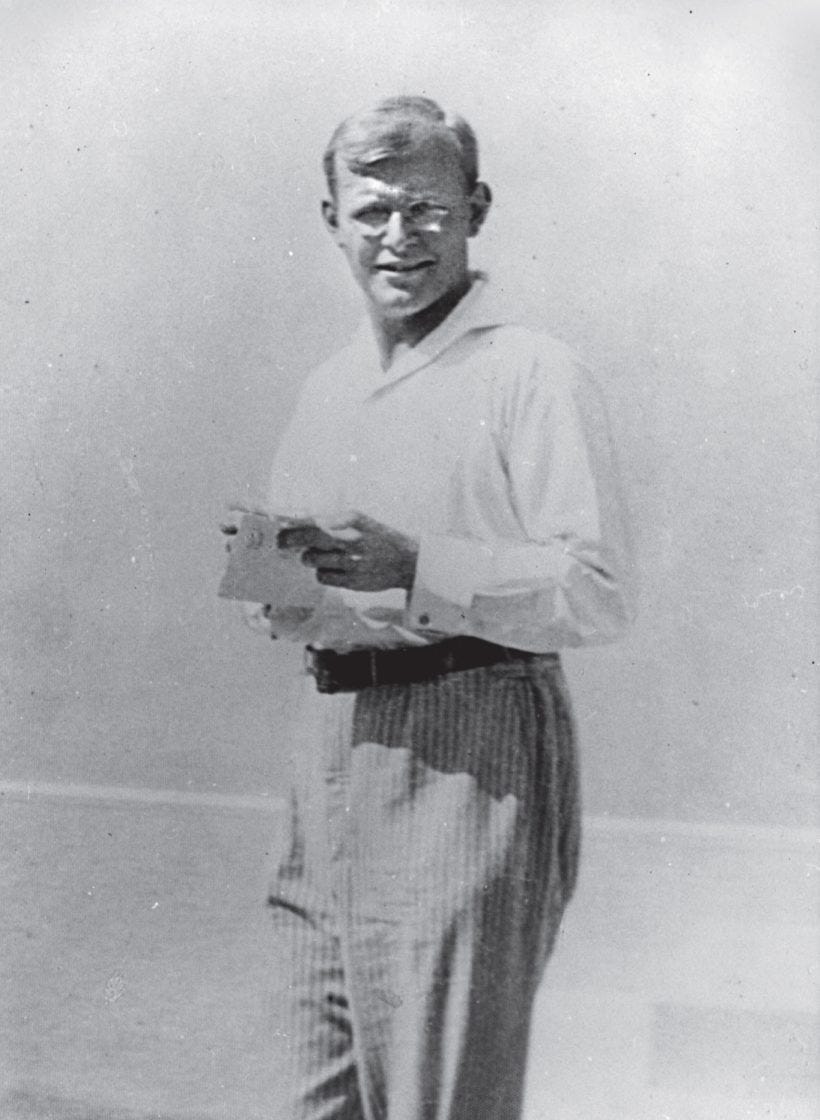
Good afternoon,
I first caught Dietrich Bonhoeffer at his end, in the prison courtyard where they hanged him. The yard is now a quiet corner a preserved Nazi camp called Flossenbürg. It’s close enough to reach by bicycle from Weiden, a Bavarian town of an almost gingerbread charm where the locally posted American lieutenants take their apartments. On a weekend I pedaled there, and came across a somber little plaque marking Bonhoeffer’s death.
So it was an accident that I came to know of Bonhoeffer. He was a Lutheran pastor who defied the Nazis when so many in so many churches accommodated them. For his defiance the Nazis killed him. Like the righteous among the nations, Bonhoeffer acted on his good principles at great risk to himself.1 I try to watch for such people, as they refute the cynic, give evidence that in each person there is a flicker of the divine.
Since then I’ve caught Bonhoeffer in other places. On Morningside Heights, where a young Bonhoeffer spent a year at Union Theological Seminary, around the corner from my own graduate studies. At Ettal Abbey outside Oberammergau, where Bonhoeffer laid low in ’41 and wrote much of his unfinished Ethics, and where I used to stop for a beer while on a weekend pass to Garmisch.2 And, time and time again, I’ve caught him in the pages of history.
But in other, more important ways, we can never quite catch Dietrich Bonhoeffer. He outpaces all but the best of us. We can only chase him, and in doing so, better ourselves. One need not deify or canonize Bonhoeffer to see as much in his short life and in his writing. Below are marginalia to this end from Bonhoeffer’s biography by Eric Metaxas, which I’ve just read.3
The first note concerns education. Dietrich’s father, Karl, was a neurologist. Dietrich’s mother, Paula, trained as a teacher. Karl and Paula had eight children. Dietrich was born the sixth of them in 1906. Even left to their own devices, Karl and Paula might have raised a brilliant family. But when Dietrich was eleven, the family moved to Grunewald, a neighborhood on Berlin’s southwest side known then as a hive of academia.
The Bonhoeffer family’s situation in Grunewald seems to have powered the young Dietrich’s education as much as any given classroom. The emergence of Humboldt’s university system and the broader institutionalization of science over the preceding century had made Wilhelmine Germany a contender for the most educated place on earth.4 The resultant professoriate joined the Bonhoeffers for dinner in Grunewald often, their children Dietrich’s playmates.
This youth, spent in the glow of Germany’s brightest minds, is charmingly captured by Dietrich’s future sister-in-law, Emmi Delbruck (emphasis added):
We had our parties and dances where wit and imagination triumphed, and skating on the lakes till it was dark, both the brothers performed waltzes and figures on the ice with a simply entrancing elegance. Then, on summer evenings, we had strolls in the Grunewald, four or five couples of the Dohnanyis, the Delbrucks and the Bonhoeffers. Of course there was occasional gossip and vexation but such things were quickly swept away: there was so much style, such a clear standard of taste, such an intense interest in different fields of knowledge, that this period of our youth now seems to me like a gift which at the same time carried and immense obligation, and probably we all felt that way more or less consciously.
This atmosphere the Bonhoeffers cultivated at their dinner table:
In the Bonhoeffer family one learnt to think before asking a question or making a remark. It was embarassing to see their father raise his left eyebrow inquiringly. It was a relief when this was accompanied by a kindly smile, but absolutely devastating when his expression remained serious. But he never really wanted to devastate, and everyone knew it.5
From that dinner table emerged not only Dietrich Bonhoeffer, one the century’s great theologians, but his brother Klaus, a brilliant jurist whom the Nazis would execute for organizing resistance to their rule, and his brother Karl-Friedrich, an assistant to Fritz Haber and chemical pioneer. His other siblings seem equally wonderful, if not blessed with Wikipedia pages (perhaps a poor measure of our legacy on earth, anyhow).
Still, despite such deep roots, Bonhoeffer showed himself to be an independent mind. Bonhoeffer demonstrated that independence not in the negative, by rejecting things close to him, but by positive action towards some new and good thing. One gets the sense this is in part how he settled on theology as his field of study, even though the Bonhoeffers were not especially religious.
Perhaps to mitigate the intellectual distance Dietrich would travel from his home, he chose a school nearby: the University of Berlin. An example of Bonhoeffer’s brand of independence came in the form of his relationship with the head of the theological faculty at Berlin, Adolf von Harnack. Harnack was a giant of German theology and a liberal. Harnack was also a neighbor in Grunewald. The two would walk to the train together, and so grew close, Harnack no doubt detecting in Bonhoeffer signs of genius.6
But on theological matters, Bonhoeffer unapologetically differed from Harnack, taking instead to the neo-orthodox writings of Karl Barth, someone maybe as close to a rival as Harnack had. To be in such close orbit of a mind like Harnack’s and adopt the teachings of his opposite suggests an independence. But it does not seem like a betrayal. Bonhoeffer managed his dissent such that he and his teacher remained on good terms.
Here’s how Bonhoeffer declared it at the Kasier Wilhelm Society memorial service for Harnack in 1930:
It became clear to us through him that truth is born only of freedom. We saw in him the champion of the free expression of a truth once recognized, who formed his free judgment afresh time and time again, and went on to express it clearly despite the fear-ridden restraint of the majority. This made him…the friend of all young people who spoke their opinions freely, as he asked of them. And if he sometimes expressed concern or warned about recent developments of our scholarship, this was motivated exclusively by his fear that the others’ opinion might be in danger of confusing irrelevant issues with the pure search for truth. Because we knew that with him we were in good and solicitous hands, we saw him as the bulwark against all trivialization and stagnation, against all the fossilization of intellectual life. 7
A third note about Bonhoeffer, one that complements both those about his education and his independence: he was a man who acted. His sense for action would emerge famously later in life, and that is well covered elsewhere. Let’s mark subtler, earlier instances here. In November, 1927 Bonhoeffer received an offer to serve as a vicar for a German congregation in Barcelona. He had no real connection to Barcelona, and it was hardly a destination for a fast riser in Lutheran theology. Still, at 21, he went:
This offer seems to bring to fruition a wish that had grown stronger and stronger over the past few years and months, namely, to stand on my own feet for a longer period completely outside my previous circle of acquaintances.
Any young person, especially one well established at home, could learn from this decision. Though Barcelona proved foreign to Bonhoeffer, a decided departure from the crackle of Grunewald dinner conversation, he found that there was much to learn from it. Here Dietrich Bonhoeffer writes to his brother Karl-Friedrich of what he found among the poor Germans in Spain:
here I meet people as they are, far from the masquerade of “the Christian world”, people with passions, criminal types, small people with small aims, small wages and small sins - all in all they are people who feel homeless in both senses, and who begin to thaw when one speak to them with kindness - real people; I can only say that I have gained the impression that it is just these people who are much more under grace than under wrath, and that it is the Christian world which is more under wrath than grace."
What a writer Bonhoeffer came to be. “Small aims, small wages, and small sins.”
Bonhoeffer’s desire to see and act in the real world among real people, without the condescension of an amateur anthropologist, he displayed again in America. There he spent the academic year from 1930-1931 with the Union Theological Seminary in New York. Rather than settle into a stretch of comfortable study, Bonhoeffer spent much of his year with his black classmate and fast friend Albert Franklin “Frank” Fisher.
Guided by Frank Fisher, Bonhoeffer saw both the churches of Harlem and the Jim Crow South. He heard Adam Clayton Powell, Sr. preach, heard gospel sung at the legendary Ayssinian Baptist Church, saw the separated trams and trains of the south, was refused service for attempting to eat alongside black Americans. Bonhoeffer returned from America both with a revulsion for such segregation and with stacks of gospel records.8 This sense for what is right and correlate penchant for action would eventually make Bonhoeffer a towering figure.
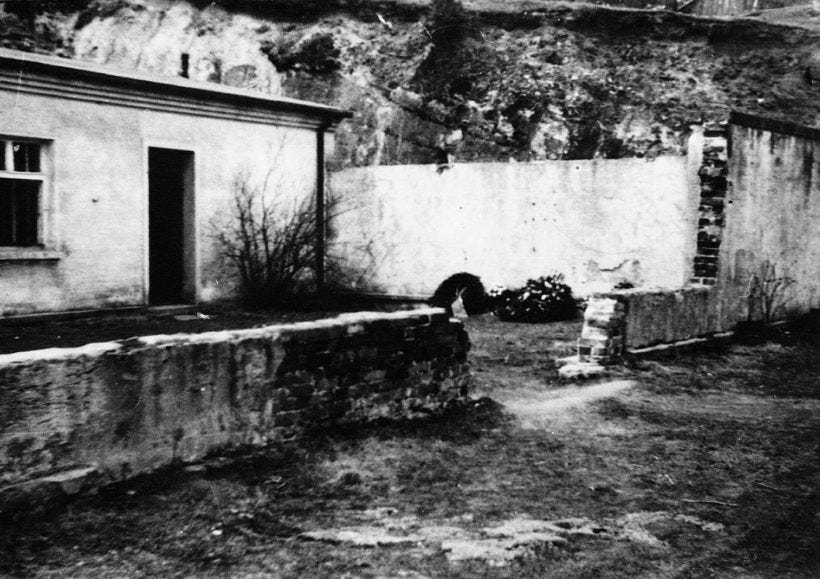
And that brings us back to Flossenbürg. One can chase Bonhoeffer’s ghost in Harlem, in Grunwewald, at Ettal Abbey. And one can aspire to chase his education, his independence, his sense for action, his godliness. But at Flossenbürg, in the courtyard where the Nazis hanged Bonhoeffer, one feels himself pulling up, having reached the limit past which one cannot follow anymore. Not because Bonhoeffer’s bravery, or his commitment to his God, is not worthy of our study, but because it is unknowable, and so irreplicable.
That I can tell, the most replicable path to that the courtyard where Bonhoeffer died on April 9th, 1945 is not Bonhoeffer’s. It is the one taken by the 90th Infantry Division the United States Army, two weeks after Bonhoeffer’s death, to liberate what remained of the camp. A good path, too. Too late to save Bonhoeffer’s life, but not too late to bear witness to it.
Rabbi Stephen Wise, whom Bonhoeffer heard speak on Easter ‘31 in New York, later sought recognition of Bonhoeffer from Yad Vashem as a Righteous Among the Nations. The request set off a debate over what qualified one for such a label that reached the Israeli Supreme Court and vividly illustrates just how fickle measuring goodness can be. Ultimately Bonhoeffer was not recognized as a Righteous Among the Nations because he did not save Jews.
The Benedictine monks make good beer at Ettal Abbey.
Worth noting that this biography and author have elicited controversy.
Van Kalbach, “German Empire historical scientific displays and the formation of the history of science discipline” Endeavour, Volume 44, Issue 4, December 2020,
These two quotes from Eric Metaxas, Bonhoeffer: Pastor, Martyr, Prophet, Spy (Nashville: Thomas Nelson, 2010) 36-37
Metaxas, 59-60
Metaxas, 95
Metaxas, 108-111
https://open.substack.com/pub/danriley2/p/screw-the-midterms?utm_campaign=post-expanded-share&utm_medium=web