
The Killing of King Lear
On murder and our fictions
“No, I’ll not weep.
I have full cause of weeping, but this heart
Shall break into a hundred thousand flaws
Or ere I’ll weep. O fool, I shall go mad!”
— Shakespeare, King Lear
Good morning,
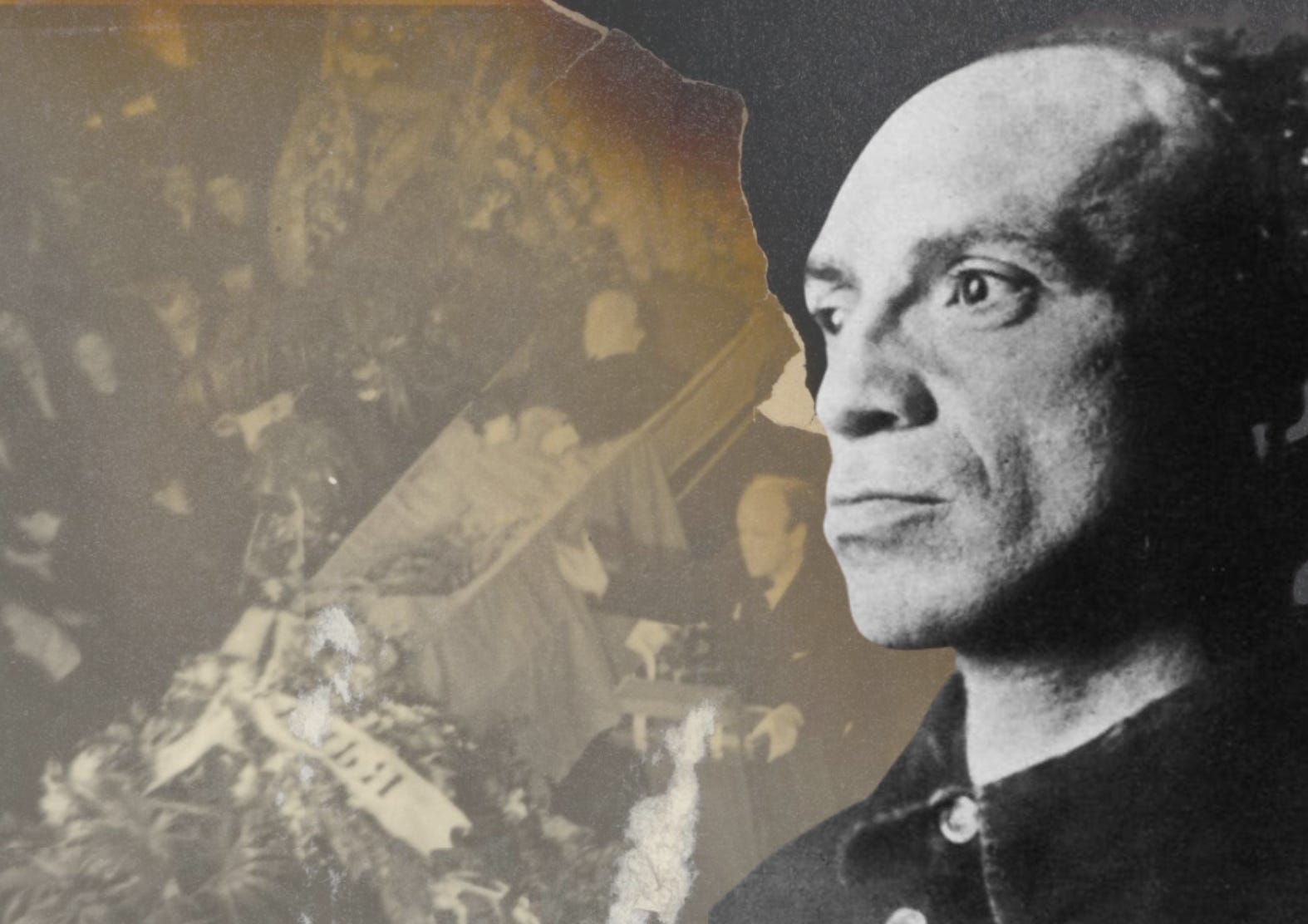
This week in 1948, a man - a holder of the Order of Lenin, a People’s Artist of the United Soviet Socialist Republics, a century-defining star of the Moscow theater - was found dead on a sleeted backstreet in Minsk. His name was Solomon Mikhoels. Alongside him was the body of a friend. The specifics of the death went unreported but his body was brought back to Moscow. There Mikhoels received a state funeral. And though the bodies were arranged to suggest a traffic accident, and in those terms he was eulogized, we now know Mikhoels was murdered.
Mikhoels’s end might have been a surprise to his younger self. He was born Shloyme Vovsi in 1890 on the banks of the river Dvina, which flows from the Russia interior through present day Latvia to the Baltic. His hometown was one of the seats of Jewish learning in the Pale, then called Dvinsk. Today it is called Daugavpils, the Dvina still flows past it, and the Jews are all but gone.
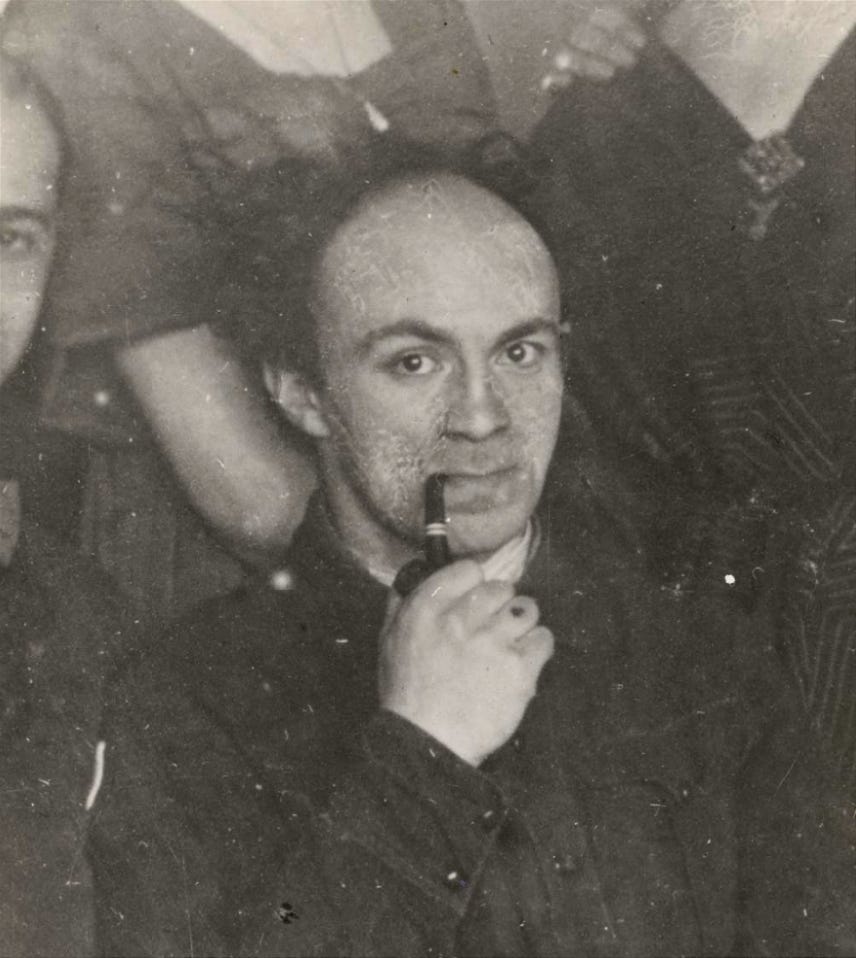
Like many Jewish boys in the late Russian Empire, Shloyme at first studied the Torah and Talmud in yeshiva, then set out for a career in the law in Petersburg. But within him even from an early age was an artistic inclination and he was born at a time when Yiddish theater troupes were approaching their zenith. They beckoned him.
Soon, the stage pulled Shloyme from law school. He joined the burgeoning post-revolutionary theater scene in Moscow and made his name as the Russified Solomon Mikhoels. In roles and plays often taken from the world of Sholom Aleichem he demonstrated a rare talent that vaulted him to the top of the State Jewish Theater, or GOSET, by 1928.
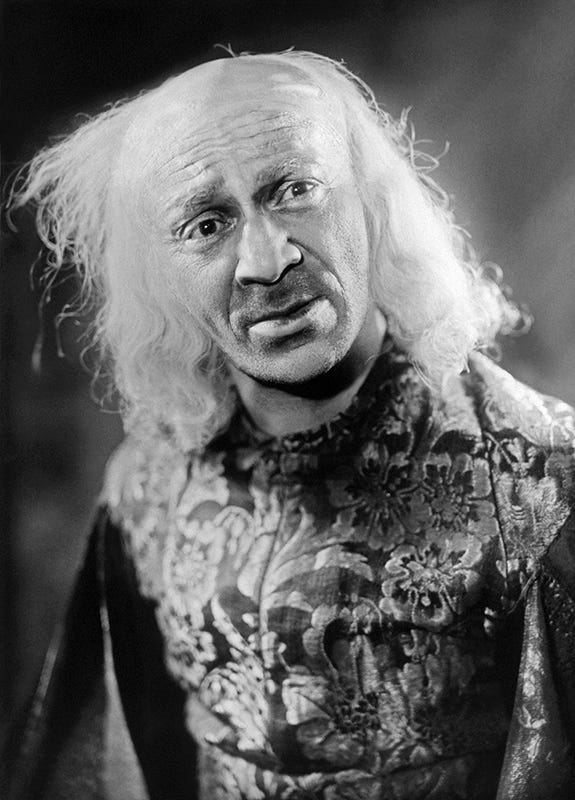
Mikhoels reached the height of his powers not in the world of Sholom Aleicheim but in the world of Shakespeare - as King Lear. GOSET put on the play at the start of 1935 for that year’s Moscow Theater Festival. Shmuel Halkin, a great lyric Jewish lyric poet, translated the play to Yiddish for the occasion. The company set the stage in bright folkish colors. Every detail received Mikhoels’s obsessive attention.1
Shakespeare was a generally safe choice in the 1930s Soviet Union, a place where incorrect literary taste could be fatal. Literati still in good graces with the Community Party like Lukács and Gorky had established, on the strength of an 1859 letter to Ferdinand Lasalle from Engels, that Shakespeare was acceptable social realism and so consuming his content would not imperil the revolution.2 Productions soon proliferated.
There were of course cracks in this Shakespearean shield. The natural choice to direct Mikhoels’s Lear at GOSET was a brilliant Shakespearean named Les Kurbas. The trouble was the Communist Party had already sent Kurbas to the gulag for the crime of being Ukrainian. In 1937, after Stalin removed the Ukrainian government entirely, Kurbas was shot. (Instead the GOSET Lear’s director, perhaps in title only, was a dramatist named Sergei Radlov. Radlov couldn’t speak yiddish but redeemed himself by being politically innocuous.)3
The result made history. We know about Mikhoels’s Lear because many contemporary viewers took careful notes of the performance and because it was filmed. These records have enabled historians and critics to recreate the performance on the page in great detail. Among later appraisals of Mikhoels’s Lear, I’ve found none more thorough than that of theater scholar Daniel Gerould, written in 1967.
Per Gerould, Mikhoels’s innovation was this: through subtle and deeply human movement, Mikhoels inverted the apparent position of Lear at the play’s start. Rather than pathetic from go, as he had often been depicted up to that point, Mikhoels’s Lear appears before a packed international audience first as a self-assured ruler. The descent from this confidence is the tragedy.
Mikhoels establishes Lear’s early self-assuredness at the play’s start by wordlessly counting those in his court, as if claiming them. As he does so, he moves not like a lunatic but with the serenity of a man who, having risen to the zenith of his earthly world, has decided to divide his kingdom as a final show of his material transcendence and of his constituting power. Here is Gerould on Mikhoels’s Lear:
Lear plans the division of his kingdom as a delibrate philosophical experiment to test his view of reality and to prove the truth of his conception of the world. Lear is sure that he will demonstrate that even after he has given away his power, he will remain exactly as he was before. The experiment backfires, and Lear soon discovers the limits of his former wisdom; once he has abandoned his position as king, he is as helpless as poor Tom. The tragic conflict arises when the individual, imagining himself to be all-powerful, comes into collision with the reality of the objective world, before whose laws the proud individual turns out to be weak and pitiful.4
As the events of the play humble Lear, Mikhoels traces his growing humility by way of a repeated gesture. Scene after scene, Lear compulsively and worryingly reaches for his crown. The message for the audience is clear: Lear knows that his power is political. Absent his crown and the political power it signifies, there is very little of him left. So Mikhoels later said:
Periodically my left hand played an important role. Now and then Lear raises his hand to his bare head, and quite without any meaning, sometimes in despair, sometimes in amazement, he passes his hand along it, trying to find the crown. And only in the last act of the tragedy, when his consciousness has become clear, does this gesture become unnecessary for him, just as the crown itself has become unnecessary for him.5
We cannot feel the performance - even the film left behind seems a grainy shadow - but reminisces give us an idea. Avraham Sutzveker, the great poet of the Holocaust and Mikhoels’s friend, recalls Mikhoels on stage, perhaps caught in the same left-handed gesture, one grown frantic by the play’s end:
“Whenever I think of Mikhoels, I imagine him…in the field at night in the midst of a storm, his hand insanely slapping his forehead.”
Mikhoels, Sutzveker continues, disappeared so completely into the character of Lear that he struggled to emerge from it after a show’s end, and so once wandered out of the theater into the Moscow night a madman, only to be discovered in a snowbank half dead the next day.6
Mikhoels’s Lear caused a big stir among Muscovites and those visiting for the 1935 theater festival. One imagines it was not just Mikhoels’s visionary performance or his departure from Jewish folklore that attracted crowds. The story of Lear, of a mad ruler who succumbs to his self delusions, must have had a special power when put on in the Soviet capital at the nadir of Stalinist oppression
Either way, word of Mikhoels’s Lear somehow reached a celebrated English dramatist and Shakespearean named Edward Gordon Craig, who was in town for the festival. The choosy Craig was skeptical and so went only reluctantly to a showing. He reportedly seated himself by the door so he could leave if, as he expected, the Jewish theater failed to do Shakespeare justice.7
Instead, Craig was floored by what he saw. The Press quoted him as saying, “I do not recall a performance that stirred me as profoundly, to the core, as Mikhoels’ performance of Lear.”8 No British Lear, said Craig, was Mikhoels’s equal.9 Some reports say Craig stood up early in the show from excitement and never sat down again, returning to every performance until the festival ended.10
Craig was not alone among foreigners in his praise. The performance is now regarded as “legendary,” “genius.” A critic for the Manchester Guardian called Mikhoels’s Lear a “noble performance,” that “finely brought out” the play’s “Shakespearean-Greek line of action: “Seldom has there been a finer exhibition of mental disease stimulated by gratitude, fraud, and revelation of truth.”11
So Mikhoels became a Soviet cultural hero. Soon he would be of much use. When war broke out between the Nazis and Soviets in 1941, a group by the name of the Jewish Anti-Fascist Committee formed in the temporary Soviet capital of Samara. The Committee had two aims. One was to marshal the prominent artists of Soviet Jewry to produce propaganda in support the new war effort. A second was to win support for the Soviets from Jews overseas.12
The JAFC, as the Committee came to be called, was not, despite appearances, some organic growth of civil society. Stalin had stamped out nearly all civil society in the Soviet Union over the preceding decade. Rather, the Communist Party directed JAFC’s formation. The Party also selected JAFC’s members, and placed spies among them to monitor conduct with foreigners.13
To head the Jewish Anti-Fascist Committee, the Party chose Solomon Mikhoels. In a country of nearly two hundred million people, Mikhoels was by then perhaps the most celebrated Jewish artist. Mikhoels not only held the Order of Lenin and bore the title of People’s Artist of the USSR, but he was still at the head of GOSET in Moscow.
Work with the Committee in support of the Soviet war effort took Mikhoels and his fellow committee members, spies included, to America. There and elsewhere, contact with the international Jewish community changed Mikhoels’s perspective on the Soviet project and the plight of Jews within it. They acquired or developed further ideas also of internatioanl Jewish unity.14
Mikhoels and his fellows returned to Moscow with these and other dangerous ideas, like perhaps increased autonomy for Jews in Soviet Crimea. Their transformation did not escape the notice of Stalin. The Soviet government closed the State Jewish Theater in Moscow in 1948.15 And just before doing so, for good measure, the secret police murdered Solomon Mikhoels.16
It happened this way: a secret policeman, on orders either from Stalin or from Lavrenty Beria himself, lured Mikhoels and his secretary or friend Vladimir Golubov, to a dacha outside Minsk under the pretense of meeting some fellow dramatists. There both were poisoned. Their bodies were brought back to Minsk and placed under a truck on a forsaken backstreet in the dead of night. With Mikhoels went perhaps the Soviet Union’s greatest Jewish artist.17
In the Norton Shakespeare anthology you may know from school there is an essay by Stephen Greenblatt ahead of the section of tragedies (Romeo and Juliet, Othello, Lear, Macbeth, Hamlet…) fittingly called “Shakespearean Tragedy”. At its start he reminds us how Aristotle defined a tragedy:
The core of a tragedy, Aristotle thought, was its action. Through the crafting of a plot of appropriate scale and coherence - neither too vast and complex nor too narrow - the successful playwright created the artful mimes, or “imitation,” of an action. The play’s central character, a person of high rank, should be neither perfectly virtuous nor irremediably vicious; moral nature somewhere between the two extremes was best suited to engage the audience in a powerful way. The greatest tragedies - for Aristotle, the supreme example was Sophocles’s Oedipus Rex - featured a fatal blunder or character flaw that brings the hero to destruction; a sudden reversal of fortune; and a powerful moment of recognition in which ignorance gives way to terrible knowledge. The effect for the audience was an intense emotional purging, or catharsis, in the experience of pity and fear.
One wonders at and about the tragedy of Solomon Mikhoels. Certainly he was an imperfect but great man who held high rank. And it seems he blundered, and met with destruction. But what was his blunder exactly? And when, if it ever came, was his moment of recognition? Did he feel the terrible knowledge? In the dacha? In America? Or perhaps in a snowbank, all those years before his death, after a transporting performance of a mad king?
It is hard to say. And when one contemplates not only the definition of tragedy but Lear in particular, the questions only come back again. Was Mikhoels a brilliant man who mistook the fickle nature of political power? Fell for a mad king? Or like that King, denied to himself a terrible truth? Went mad in such denial? It is again hard to say. But Mikhoels’s life is a tragedy worth marking, and not only because Mikhoels it seems was a remarkable man. His story is also a reminder that Shakespeare is perhaps our greatest realist, a realist more penetrating than even Stalin guessed.
Gerould, Daniel C. “Literary Values in Theatrical Performances: ‘King Lear’ on Stage.” Educational Theatre Journal 19, no. 3 (1967): 312–313. https://doi.org/10.2307/3205239. It should be noted that the direction was done by Sergei Radlov, but only because a (by many accounts genius) Shakespearean named Les Kurbas had already been sent to the Gulag by Stalin for the crime of being Ukrainian. In 1937, after Stalin removed the Ukrainian government entirely, Kurbas was shot.
Makaryk, Irena. Shakespeare in the Undiscovered Bourn : Les Kurbas, Ukrainian Modernism, and Early Soviet Cultural Politics (Toronto: University of Toronto Press, 2004), 199
Ibid., 194
Gerould, 314-315
Gerould, 313
Sutzkever, Abraham. From the Vilna Ghetto to Nuremberg: Memoir and Testimony, (McGill-Queen’s University Press, 2021). 262
This detail I choose to believe. I got it from the Mikhoels entry on the Russian-language website “Russian Shakespeare,” and haven not to take the time to corroborate it independently.
Jeffrey Veidlinger, “Mikhoels, Solomon Mikhailovich, The YIVO Encyclopedia of Eastern European Jews, https://encyclopedia.yivo.org/article/1286
Makaryk, Shakespeare in the Undiscovered Bourn, 195
This from a lecture given by Vadim Gaevsky in 2020.
Carter Huntly, “Moscow Theater Festival: The Soviet’s Shakespeare”, The Manchester Guardian, October 25, 1935. Not all foreign critics liked Mikhoels’s Lear - it got a decidedly negative review from the Spectator’s Philip Hope Wallace. But it seems consensus solidified over time amon critics that Mikhoels’s Lear approached greatness.
Gennady Estraikh, “The Life, Death, and Afterlife of the Jewish Anti-Fascist Committee”, East European Jewish Affairs, 48:2, 139-148, DOI: 10.1080/13501674.2018.1524737
Ibid.
Ibid.
Chambers, Colin, ed. The Continuum Companion to Twentieth Century Theatre. (London: Bloomsbury Publishing Plc, 2003.) 708
Estraikh, “The Life, Death, and Afterlife of the Jewish Anti-Fascist Committee”
These details are recorded several places, but I took this description most directly from Clive A. Giller’s introduction to the book Gusarov’s My Papa Murdered Mikhoels (Lanham: Hamilton Books, 2015), p. x
I believe Pasternak translated Shakespeare. I've always imagined he must be the most difficult English writer to bring into any other language.
Wonderful!